![]() Courtesy of National Park Service |
Snakes
in the Grand Canyon? Have you seen any? Coming up Nankoweap on a very hot day in August, and very very thirsty, I went to where Jerry Gephart and I had cached a bottle of water behind a big boulder, out of the sun. To my dismay and complete surprise, wrapped around my 1.5 liter water bottle was a Rattlesnake! He was as shocked as I was! Do you want to hear what he sounded like? Just click here!
Do you have any Grand Canyon Rattlesnake pictures - or a rattlesnake story? Send me one and I'll post it here! |
Have you seen any?
On April 21, 2001 on the Lava Falls Route I saw my first Rattlesnake of the year, a Great Basin Rattler. A real beauty, light brown with dark well defined splotches, about 18 inches long! She never even rattled, just calmly moved away out of the path of my big Solomon hiking boot. I was too excited to get a picture!
Canyon John saw a small diamondback at the Toroweap / Lave Falls Overlook.
About 20 yards back from the edge. September 27, 2000Scott C. Dorman from Tabor City, North Carolina writes: During the summer of 1991, after spending the week at Clear Creek, myself and my hiking partner had just broken through to the plateau from Clear Creek Canyon, when we spotted a very PINK and very load rattler. It was around 2 to 2 1\2 foot in length and seemed very slender compared to the Eastern Diamond Backs and Timber rattlers I am familiar with. After rattling for about ten seconds, he cleared the path and slithered under some rocks. We did snap a picture but he was under the rocks and when developed you cant even see him in the dark.
Here are some photos of these fascinating creatures!
This rattlesnake photo was taken at 3000' near the confluence of Nankoweap and the River, April 1998. The encounter occurred around noon, about mid '70's for a temperature, the snake did not rattle and was a big one, appeared to be over 4 feet long, and I believe it's a Grand Canyon Rattler.
Canyon Rattler photo by Dean Boeckman
Jeff Truby and Len Becker saw this beauty at Deer Creek, at 4PM, on 9/21/2002. The snake was on the trail, rattled, then slowly proceeded to the brush, where he coiled. Jeff almost stepped on him!Rattler Photo by Len Becker
John Howard saw this Rattlesnake and took the photo. This last May, 2004 trip we saw two rattlesnakes: The pink colored (Hopi?) one pictured below we encountered at dusk hiking up Forster Canyon. Luckily, my camera had a flash. I'd estimate it was about 40 inches long. It buzzed at us for a minute or so before sliding off. The very next evening, hiking from our camp across from Deer Creek Falls, we encountered another rattlesnake. It was near an overhang that looked like an Anasazi site. This rattler was more brown, definitely not the pinkish variety we saw the evening before.
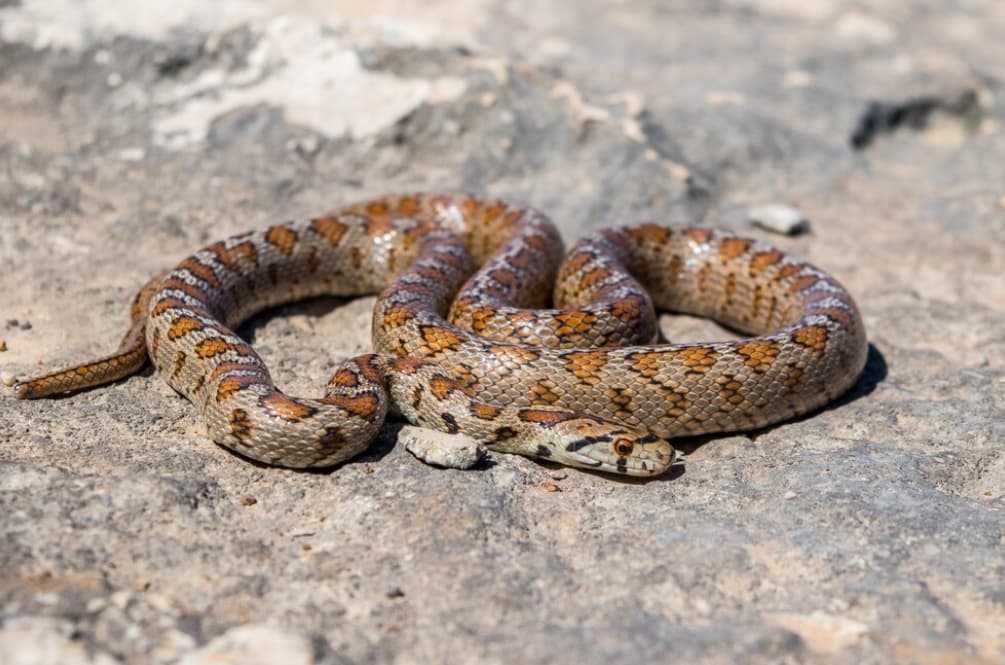
A Gopher snake resembles a rattlesnake in every way except, he has no rattle, and is not poisonness!
Gopher Snake photo taken by Murray LevineLeslie Robertson spotted this snake in October 2004
Murray Levine says, "At about 3,500' at around 0930 the one in the photo which I estimated at 4' was slithering ever so slowly across the trail. After not seeing anything resembling a rattle on its tail I took a photo."Nikolle Brown reports:
Gopher Snakes are 'common' in the Canyon (my records/database and published info) and given they do resemble a rattlesnake in patterns, they will many times (in defense) also perform a display of raising and shaking their tail, imitating a rattlesnake.
Also, I have come across (personal experience) rattlers in the canyon that have rattled while moving (thank goodness). The coiling aspect just gives them more distance to strike.You can reach Nikolle at
black-catnik@worldnet.att.net
Gary Barnes snapped this photo on the Bright Angel Trail between the River resthouse and the Devil Corkscrew switchbacks in August 2003."Snake was in a hurry to get across the trail and luckily I got his photo as he made his escape."
I made this picture on June 4, 2006 while hiking from the north rim to the south rim. It was made between the pump station and Cottonwood at about 9:00 AM. It appeared to be approximately 36-40 inches long.
Randall Morton
Boaz, Alabama
The second photo of the little one was made right past Cottonwood on the same day, June 04, 2006. It was only about 18 inches long. Two rattlers on the same day, pretty awesome. Randall Morton
Boaz, Alabama
Since reptiles are well suited to desert environments they are found in all the life zones in the Grand Canyon. They must try to avoid the heat of the summer days, and in the summertime are only active in the morning or early evening or even nocturnal. In the winter most species hibernate. Reptiles are uncommon on the Kaibab Plateau-it's just too cold for them!
Rattlesnakes are rarely seen by visitors. I have seen as many as three on one hike, in the Supai area of the Great Thumb, most on most hikes I don't see any. On one hot summer day, I found one wrapped around a water bottle I had left for the hike out. Don't forget, almost all bites occur while attempting to handle or harass a snake. They are very retiring, and will run for the nearest rabbit brush or boulder when they observe your presence. Word is they can strike out 1/2 their body length. That would be about 1 or 2 feet for most Canyon rattlers.
Grand Canyon Snakes include:
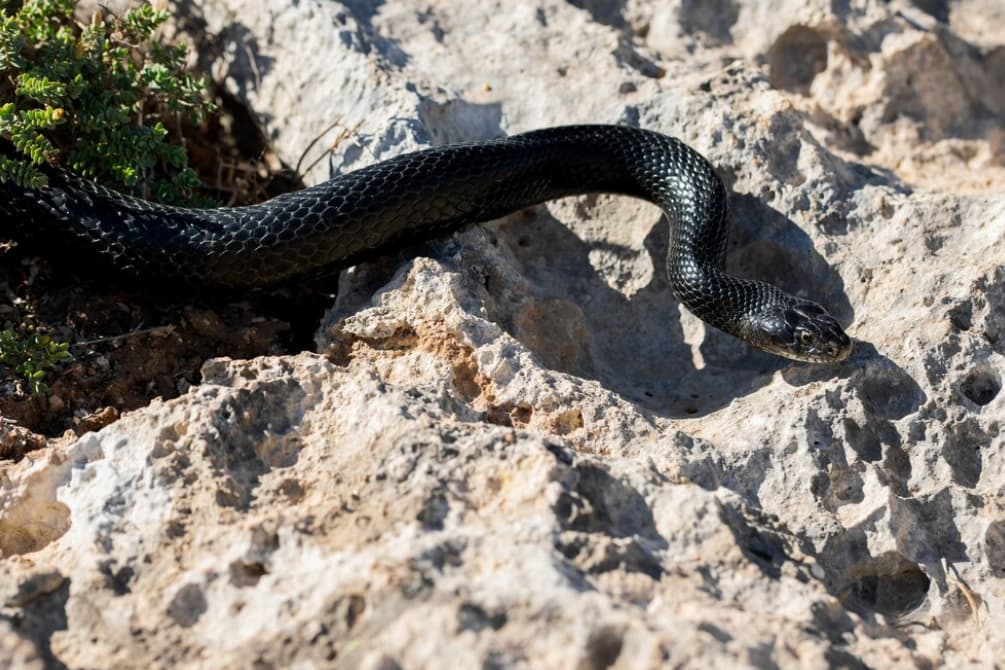
- Desert Striped Whipsnake, found in shrubs along stream beds
- Gopher Snake, narrow head and no rattles, but will mimic a rattlesnake when threatened. This one does a great imitation of a rattlesnake!
- Long-nosed Snake, white bands
- Common Kingsnake, among rocks and brush
- Wandering Garter Snake, looks green often but the color can vary
- Western Rattlesnake have a triangular head with a heat sensing pit between the nostils and the eyes, and the rattle! Remember, a baby will not rattle because he doesn't have rattles yet. They look cute, but are just as dangerous as their parents. The Western Rattlesnake includes the four sub-species:
Grand Canyon Rattlesnake, light brown with splotches
Hopi Rattlesnake, pink, green or grey with splotches
Great Basin Rattlesnake, light brown or grey with dark splotches
Speckled Rattlesnake, pink/reddish, found below Havasu
How to act around the rattlesnake!
Most snakebites in humans are the result of a snake
defending itself when it feels threatened. I have rarely seen a rattlesnake that didn't
try to get away from me as fast as it could. Chances are, with your big pack the snake
will hear you coming and move out of the way to a rabbit brush or a big rock. They may
sense ground vibrations better than sound.
When you do unexpectedly confront a snake, stay calm, back away, and don't threaten it.
Most of the time I've jumped back about 5 feet from the shock!
Don't walk barefoot around camp, especially after dark. During the hot summers snakes will
be most active at night and will defend themselves if stepped on or if you walk too close
and they sense danger. Boots and long pants are an excellent defense against a bite.
Snakes hide under rocks, logs, and brush to protect themselves from sun or cold. Be very
careful about moving rocks or reaching into anywhere a snake might hide. A snake
might think your actions are aggressive and defend itself. There may be more than one
snake in the same place and, taken by surprise, they may strike without warning.
Furthermore snakes will be more likely to bite your unprotected hand rather than a leg or
foot protected by clothing. Climbers need to be extra careful in the Canyon during warm
weather. Snakes like to sun themselves on ledges. I once came face to face with a Pink
Rattler while off route above Lava Falls. He would of struck me right on the nose or face
if I was in range!
Snakes and the Bites!
Here is some general Rattlesnake information.
Venomous snakes in the U.S. all belong to one of two families, Crotalids, pit vipers; and
Elapids, coral snake.
Crotalids include the numerous species of rattlesnakes and will be discussed here.
Crotalids have the most efficient injection mechanism of any snake. They are equipped with
long hollow fangs and a system to inject venom through those fangs. They have the ability
to inject large volumes of venom quickly. Crotalid fangs can fold back into the mouth;
lack of visible fangs does not necessarily mean an unarmed snake. Most crotalids have
venom that is less toxic than that of coral snakes. Crotalids, however, are the more
dangerous group because they are more likely to bite a human, they can inject venom
much more efficiently, and they are usually larger and have more venom to use.
Snake's Venom
Snake venom usually contains two types of poison: hemolytic toxins which attack the walls
of blood vessels and neurotoxins which attack the nerves.
Hemolytic toxin attacks blood vessel walls, allows serum to escape into the surrounding
tissues, and causes clotting within the vessels. The result is severe swelling, pain, and
discoloration at the site of the bite. In the few cases where hemolytic toxins cause
death, the actual cause is likely to be shock. The effects of hemolytic toxin are
immediate and primarily localized. Symptoms will be obvious.
Neurotoxins produce much less obvious immediate symptoms, at times fooling the victim into
believing envenomation has not occurred. But systemic symptoms can appear later.
Neurotoxins produce much less local reaction than do hemolytic toxins. On the other hand,
they can affect nerves quite removed from the site of the bite. In extreme cases they can
cause
respiratory arrest, although this is uncommon with the bites from most North American
snakes. However, respiratory distress without actual arrest may to occur in neurotoxin
victims. Less severe symptoms from neurotoxins include tingling or prickly feelings and
eyelid paralysis.
All snake venom probably has some of each kind of toxin. But, most pit vipers have a
higher fraction of hemolytic toxin, and elapids have more neurotoxin. The Mojave
rattlesnake, a pit viper, is an exception. The potency of venom will vary, with species,
with time of year and with geographic area.
The typical snake mouth is no cleaner than a human's. So, they tend to induce microbial
contamination into bites. Although it is common for a snake to bite without injecting
venom, microbial contaminants will always be present and should always be treated. Such
contamination seems to be much less of a problem in bites by nonvenomous snakes, perhaps
because their bites do not penetrate so deeply.
Diamondbacks, rare in the Canyon, are potentially deadly. Both the
eastern and western versions are huge, the western species compensating for its slightly
smaller size with a more potent venom. MFM lists the eastern diamondback as an aggressive
snake and claims it is responsible for more human deaths than any other U.S. snake. Others
dispute this. Some say it is not particularly aggressive and quotes some numbers which
indicate that it is unlikely to lead in killing people.
The Mojave rattler is dangerous in spite of its size. This little rascal
is armed with a very potent venom, high in neurotoxins. Pain and other local responses to
the bite may be mild, but the systemic response may be marked. Initial reaction is usually
mild with severe symptoms coming 12 to 16 hours after the bite. The early symptoms could
easily fool one into believing there was no problem. By the time severe symptoms appeared
the best time for treatment would have passed.
Envenomated bites from either the diamondback or the Mojave
rattler are serious, possibly even deadly. Do your level best to evacuate the victim
quickly to medical facilities as soon as possible.
For more information please contact:
Antivenin Index in Tucson AZ 520-626-6016
Treatment of a Bite
Please don't panic! Snakebites should be treated carefully and conservatively. Don't jump in with knives, tourniquets, ice, or compression bandages. There is no need to try to suck out the venom by mouth. Carrying out any of these extreme procedures has the potential to do far more harm than good. Victims should be given only the appropriate treatment and then be rapidly evacuated to medical facilities.
Sources:
The Venomous Reptiles of Arizona from
Arizona Game and Fish
The Journal of Herpetology
A Field Guide to the Grand Canyon by Steven R. Whiney
A Natural History guide to the Grand Canyon by Jeremy Schmidt
The activities described in this web site are potentially dangerous. Canyoneering, rock climbing, and mountaineering involve unavoidable risks including the risk of serious bodily injury and death. All forms of wilderness recreation have a higher level of risk than most ordinary activities. The owner and publisher of this web site do not assume any responsibility or liability for your safety. Those who use this information, and those who venture onto mountainous terrain, do so at their own risk. Disclaimer
|
|
All contents of all pages Copyright © 1997- 2007 by Mike Mahanay. All Rights Reserved Much of Treks is a
compilation of various contributors! If so, drop me a
|